The Four Practices That Cut Through Everything Else
Top-performing managers stand out because they consistently apply these four best practices wherever they coach.
Practice #1:
Coach to Skills Because Skills Move the Needle
The Problem
Too many coaching conversations drift toward reviewing metrics, performance dashboards, or competency checklists; all valuable, but not coaching.
When managers spend field time dissecting call reports, reach-and-frequency stats, or pipeline numbers, they're managing activity. When they check boxes on generic competency assessments, they're documenting compliance.
To be clear, these are important tasks when it comes to being an effective field sales leader. But they’re not making your team better or laying the foundation for sustained sales success.
The Move
Real coaching zeroes in on skill; the observable behaviors that drive performance and strategy forward.
In Echelon's 2025 analysis of what makes exceptional managers tick, we found that 72% of coaching from top-performing managers focused on skills directly aligned with commercial strategy. For average managers? Only 44%.
That's a 64% difference.
Strategies evolve, but coaching skills-centric coaching is a proven force multiplier.
Which Skills Do Top Managers Focus On?
The “skills that matter” will always be driven by your team’s and your leadership’s strategy. But, in reviewing coaching reports and coaching conversations, we find that top-performing managers tend to focus their coaching on skills that fall into three buckets.
1. Customer engagement skills (selling fundamentals). Top managers know (because they have been top-performing reps at some point) that the ability to influence customers in the moment is critical to success. Even in organizations that don’t have a formal selling model or robust competency model, top managers focus on skills that foster customer engagement. Top skills here: the use of questions to extend calls, which gains commitment.
2. Brand strategy execution (messaging, visual aids, market access). Top managers adhere to marketing strategy. They know that brand teams are continually working to research and refine core messages, designing the most effective messaging strategy and gaining access for the brand wherever they can. Top managers internalize these strategies and focus on the skills their team needs to drive these messages home. Top skill: fluency with clinical resources.
3. Planning (business planning, territory strategy). Top managers want their people to think strategically. They know the most precious resource for all their reps is time. They focus their coaching in large part on how to maximize this resource and have the biggest impact across accounts. Top skill: planning (call, account and territory).
FUN FACT: More than half (55%) of top managers' coaching reports included feedback on clinical engagement. Among average managers? Less than 20%.
Why It Works
Skills compound. Metrics tell you where you've been; skills determine where you're going.
You can review dashboards in a conference call. You can't develop clinical fluency or closing skills without observation, feedback, and practice.
When coaching focuses on the skills that drive strategy, managers become force multipliers. When it focuses on scorecards and spreadsheets, they become performance reporters.
Reflection
Think about your last field coaching report. Did you coach:
-
- The metrics? (Necessary for accountability, but not developmental)
- The competency checklist? (Documentation, not coaching)
- The skill? (High value, lasting impact)
Back to Top
Practice #2:
Set Skill Goals to Build Momentum
The Problem
"Groundhog Day Coaching." The same field visit, different month, little variation.
Sometimes field sales coaching can fall into this trap. A lot of managers have been in their roles for five, ten, even 20+ years. In that time, it’s easy to get into a “comfort zone” with team members. When this happens we like to say that a manager’s relationship capital has outstripped their development capital. And it can happen to even the best of field sales leaders.
The Move: Set and Coach to Skill Development Goals
In an ideal world, every coaching interaction will connect to the previous one and set up the next. In this approach, there is momentum in skill development. When a manager sets a long-term skill development goal, it's impossible for today's field visit to look and sound just like last month's or last quarter's. These goals can be short and simple:
“Ed, over the next four months, our focus will be on moving from level 2 in active listening to level 5. This will enhance your engagement with HCPs and demonstrate to them that you’re keen to learn more about their practice and the way they manage appropriate patients.”
Now, to be fair, you just can’t spring this goal on Ed. you need to align with Ed on the goal-setting process. You want to talk about how specific skills will help Ed build his face-to-face presence and result in the kind of HCP relationships Ed needs to develop his territory.
After that, every field visit, every coaching interaction needs its own short-term goal. This sounds like:
“Ed, as you know we’re working to get to level five in active listening. For today, I'd like to see you incorporate some of the methods we practiced last time during your lunch at Mercy Medical. Let’s see if we can extend the duration of your interactions by 25% today.”
FUN FACT: Top managers were twice as likely to reinforce long-term skill goals and three times as likely to include a development goal in their coaching plan. They focus on one or two skills until proficiency improves, then connect that goal to each field visit. Among average managers? Nearly 25% made no reference to long-term goals. More than half had no stated goal for the visit.
Why This Creates Momentum
When you create visible growth pathways through connected coaching moments, something shifts: your team stops seeing coaching as something done to them and starts seeing it as development they own.
Goals make development tangible. Momentum keeps both manager and team member accountable and engaged.
Action Item:
-
- Before your next field visit, consider the team member you’ll be working with. Do you have a skill development goal in place? Were they involved in creating that goal? If so, great! Think about your short-term goal and what small change you’d like to see during the course of the day.
- If you don’t have a long-term skill development goal in place, dedicate the first part of your field visit to co-creating a skill development goal that will have a direct and positive impact on your team member’s business. Make sure you capture that conversation in your FCR and use it as a guide for planning your ensuing field visits.
Back to Top
Practice #3:
Engage Your Team Member in Every Facet of Coaching
The Problem
Coaching to people doesn't work. Creating a sense of shared ownership does.
The Move
The coaching cycle isn't manager-led theater. It's a collaboration.
Highly effective managers were more than four times as likely to engage team members throughout the coaching process, from goal-setting to follow-through.
The Four Phases of the Coaching Cycle
When we use the word “coaching” most people will think of two people engaged in developmental dialogue.
To be fair, effective developmental dialogue is a cornerstone of effective coaching. But it’s not the be-all-end-all. Effective coaching is made up of four distinct phases, each of which offers a unique opportunity to invite your team member to take an ownership stake in his or her development.
1. PLAN:
As a manager, ask yourself: "When I ride in the field with this team member, what skill are we focusing on, and why does it matter?"
Think about how many times you’ve heard about the importance of territory planning and call planning as a rep. Hundreds, maybe thousands of times.
The same principle holds true for managers and coaching. As a rep, a cardinal sin is to go into a day in the field or any call without a goal and a plan. If you’re a manager about to spend a day in the field with a member of your team, you must have a goal. And, when it comes to coaching, your rep needs to have their own goal as well.
Let that sink in. Your reps need to show up to your field day with the mindset of which skills they want and need to be coached on.
This type of shift doesn’t happen in a vacuum. Engage your rep in pre-call planning. Don't just tell them what you'll observe. Ask them what they want to work on and why it connects to their development goals. Ask them directly - what opportunities have you created for me to observe you leverage this skill?
2. OBSERVE:
Real-time, real specifics.
One subtle shift that can help supercharge your coaching is to hone your ability in the role of Observer. Let’s be real - in some cases, you need to be actively involved in customer engagement, both in good times and when the train is going off the rails.
But, in 80% of customer engagement settings, managers can enhance their coaching by focusing on their team member’s skill execution and the impact it has on the outcome of that call. Sometimes you might need to intervene, but your time is better spent collecting specific examples of skill execution.
As a manager, your ability to observe is every bit as vital to your coaching as having a developmental dialogue. As much as we like to engage with customers and support reps when they’re selling, we need to purposefully adopt the role of Observer in Chief during our time with customers.
Our observations - the specific examples of real-time execution and impact - are the backbone of coaching. They are the foundation of skill goals and help your team members get an exact read as to where they stand when it comes to the skill or skills they’re working on.
At the end of a call, a day, or a multi-day field visit, your observations are key to answering:
• What skills were observed?
• When? In which calls and and with which practitioners?
• How did that level of skill execution impact the outcome of the call?
• Where do we go from here? What does the next level of proficiency look like?
3. DIALOGUE:
Co-construct insights (don’t deliver verdicts).
We could produce an entire e-book just on developmental dialogue. In lieu of that, here are two quick tips to facilitate deeper face-to-face engagement:
1. Lead with questions, not observations. Actively engage your team members and draw them into the dialogue.
2. Listen. Put away your phone. Drop your agenda and be the sounding board that your team needs. Be the expert. If your team member is struggling with a skill, be prepared to model that skill the way you want. If you want Ed to be at Level 5 in active listening, what better way to create that vision for him than modeling that behavior?
4. FOLLOW-UP:
They own the next steps.
Top managers don't let coaching die in the field coaching report. They ensure that team members take ownership for their own development by assigning skill-building exercises to each team member at the end of a field ride.
We call this Actionable Coaching. And it sounds like this:
"Sarah, given the complexity of treating conditions like coronary artery disease with comorbid conditions such as congestive heart failure, it's crucial to engage deeply with healthcare professionals about their treatment strategies. For our next visit with Dr. Mitchell, I want you to prepare three open-ended questions that explore his current approaches."
This puts the onus of development on Sarah. Where it should be.
For extra points, put the onus of scheduling a follow-up on Sarah as well.
“Find a time on our calendars that works for both of us and send me a meeting. We can review your questions then.”
The Bottom Line
Autonomy + accountability = engagement.
Development isn't something you do to someone. They have to earn it. When you make them active participants, vs. passive recipients, they lean in.
Back to Top
Practice #4:
Leverage High-Quality Coaching - The BASICS
The Problem
Not all coaching creates lift. Some just creates confusion.
You can coach frequently and still get nowhere if the quality isn't there.
The Move - The BASICS: Six Criteria That Make Coaching Matter
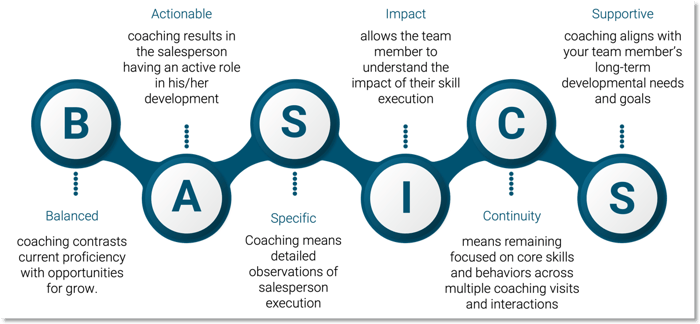 For nearly 20 years, Echelon has identified and refined six criteria associated with effective coaching quality. These criteria, known as the BASICS, separate coaching that drives performance from coaching that just fills out forms.
These six criteria form the backbone of high-quality coaching. When managers use them consistently, they transform everyday field interactions into development moments that actually move skills, confidence, and business performance forward.
In a world full of noise, policy changes, market shifts, access challenges, organizational updates, the BASICS help managers stay grounded in what truly grows people.
B — Balanced
Practical Definition:
Balanced coaching paints a clear picture of where a representative is today and what “better” looks like. It contrasts current proficiency with the desired state in a way that’s honest, fair, and focused on growth, not judgment.
Real-World Example:
A manager rides along with a top-performing rep who has strong relationships but tends to rush through clinical explanations. Rather than generalizing (“your details are good”), the manager acknowledges the rep’s strengths while calmly pointing out the moments where clarity slipped. The rep leaves understanding what they’re doing well and what they could sharpen to elevate conversations even further.
What Good Looks Like (Integrated):
During a recent field visit, a manager noted that the rep responded confidently to Dr. A’s questions but delivered the information so quickly that the message became hard to follow. The manager explained that deeper provider engagement relies on clear, digestible communication and suggested slowing the cadence to create space for reflection and dialogue. The rep walked away knowing exactly how improving this one skill could strengthen future interactions.
Coaching Prompt:
“What did I observe today, and what would ‘one level higher’ look like in this same skill?”
A — Actionable
Practical Definition:
Actionable coaching gives reps clear, doable next steps they can take on their own time, not vague encouragement or administrative tasks. It turns feedback into practice.
Real-World Example:
Instead of saying, “Work on asking better questions,” a manager might help the rep identify one specific situation coming up this week and set a concrete task: write three probing questions tailored to a key provider. The rep leaves with direction, ownership, and something they know how to execute.
What Good Looks Like (Integrated):
A manager notices that Sarah often moves too quickly past opportunities to probe. After a few similar calls, the manager asks her to draft three open-ended questions that explore one physician’s challenges with identifying appropriate patients. Sarah is asked to send them in advance so they can review together. The task is simple, specific, and builds a habit that can easily transfer to future discussions.
Coaching Prompt:
“What is one specific action this rep can take in the next week that builds the skill we talked about today?”
S — Specific
Practical Definition:
Specific coaching zeroes in on observable behavior: what was said, how it was delivered, and how it affected the interaction. It avoids generalities (“good call”) and instead highlights precise moments that the rep can repeat or refine.
Real-World Example:
Rather than telling a rep, “Nice job getting the commitment,” a manager recalls the exact phrasing the rep used and shows how it opened the door for a deeper clinical dialogue. This level of detail helps the rep understand why the moment worked and how to recreate it.
What Good Looks Like (Integrated):
One morning, a manager watched a rep secure a commitment from Dr. S to attend an educational program. By reinforcing the specific behaviors, a clear, confident invitation tied to value for the provider. The manager highlighted why the approach landed so well. They encouraged the rep to keep using that exact technique when engaging multiple providers within the same practice.
Coaching Prompt:
“What exactly did I see or hear that mattered, and how did it change the call?”
I — Impact
Practical Definition:
Impact coaching connects a skill to its outcome. It explains why a behavior matters and how it influences access, prescribing, understanding, or provider engagement. When reps understand the “why,” they’re more motivated to build the “how.”
Real-World Example:
During a call, a rep asks a thoughtful question about how a physician’s treatment approach has evolved with new therapies. The manager later shows how this single question changed the physician’s tone, opened a richer conversation, and positioned the rep as a strategic partner. The rep sees not just the skill but the effect.
What Good Looks Like (Integrated):
A manager observed a rep ask Dr. H about her experiences navigating new treatment options. The question immediately shifted the conversation. The doctor became more animated, shared patient stories, and asked for more clinical depth. The manager highlighted how open-ended, experience-centered questions deepen trust and create space for higher-value discussions.
Coaching Prompt:
“How did this skill affect the outcome of the call, and what future impact could improving it have?”
C — Continuity
Practical Definition:
Continuity ensures that coaching builds over time. It links today’s discussion to what was coached last month and reinforces progress with follow-through. It prevents coaching from becoming a series of isolated conversations.
Real-World Example:
Before field visits, a manager reviews past coaching notes and checks in on agreed-upon skill goals. When the manager notices progress, even small wins, they reinforce it, and when gaps remain, they refine the plan. The rep sees consistency and a sense of forward motion.
What Good Looks Like (Integrated):
A manager who previously coached a rep on improving long-term treatment discussions saw meaningful improvement during a recent visit with Dr. A. The rep connected clinical study data to patient care decisions, and the physician responded with interest. The manager reinforced this progress and encouraged continued focus on framing discussions around the provider’s top concerns.
Coaching Prompt:
“What did we work on last time, and how am I helping us move that same skill forward today?”
S — Supportive
Practical Definition:
Supportive coaching ties today’s feedback to a rep’s long-term goals: skill mastery, professional growth, career aspirations. It situates the coaching in a meaningful personal context.
Real-World Example:
A manager remembers that a rep wants to become a field trainer. During a coaching session, the manager links a feedback point, improving clinical storytelling, to the rep’s goal of guiding others. The rep sees how today’s improvement supports tomorrow’s opportunities.
What Good Looks Like (Integrated):
Knowing a rep aims to strengthen patient-centric conversations, a manager acknowledges how effectively they humanized the therapy message in a discussion with Dr. C. The manager connects this to both their professional aspirations and the value it brings to providers and their patients, reinforcing why developing this skill matters in the bigger picture.
Coaching Prompt:
“How does this feedback connect to what this rep wants to become, not just what they need to fix?”
Back to Top